
God and Monsters
"Was man, indeed, at once so powerful, so virtuous and magnificent, yet so vicious and base?"

The summer has come and gone; fall is in full swing. As the days grow short, the nights turn long; the shadows creep with a lingering creepiness that suggests there is more out there than what simply meets the naked eye. Maybe there is…
There’s a reason that horror, as a genre, is often associated with this time of year. There’s a chilly, eerie feeling that crawls down one’s spine as the leaves turn and the trees fall bare. As the seasons shift, what was once warm grows cold, and we spend more time indoors and less in the wonders of creation. We prepare for the winter, and in doing so become more introspective.
It is at this time of year that I most enjoy revisiting supernatural thrillers and psychological horrors that speak to the human condition—whether our insatiable desire to play God, tumultuous struggles with personal darkness, or the valiant war fought between good and evil. Contrary to what many have been told, horror is like any other genre in that it can be used properly to challenge and edify, or it can be used improperly only to frighten and despair.
It’s simply about the message.
In 1935, Universal Pictures recognized the potential of its growing collection of in-house monsters. Four years earlier, the studio had brought the stage play adaptation of Dracula to life on the screen, with the ever-iconic Bela Lugosi as the titular count. By the end of that year, Frankenstein was released, and from there, The Mummy and The Invisible Man followed.
It wasn’t long before Universal released its first sequel, Bride of Frankenstein, a film superior in many respects to the original. For one thing, it was more accurate to the character’s motivations from the Mary Shelley novel. It was also riddled with dynamic performances and offered a more tragic and intelligent take on the creature played by Boris Karloff. All in all, Bride of Frankenstein is something of a crown jewel when it comes to classical horror.
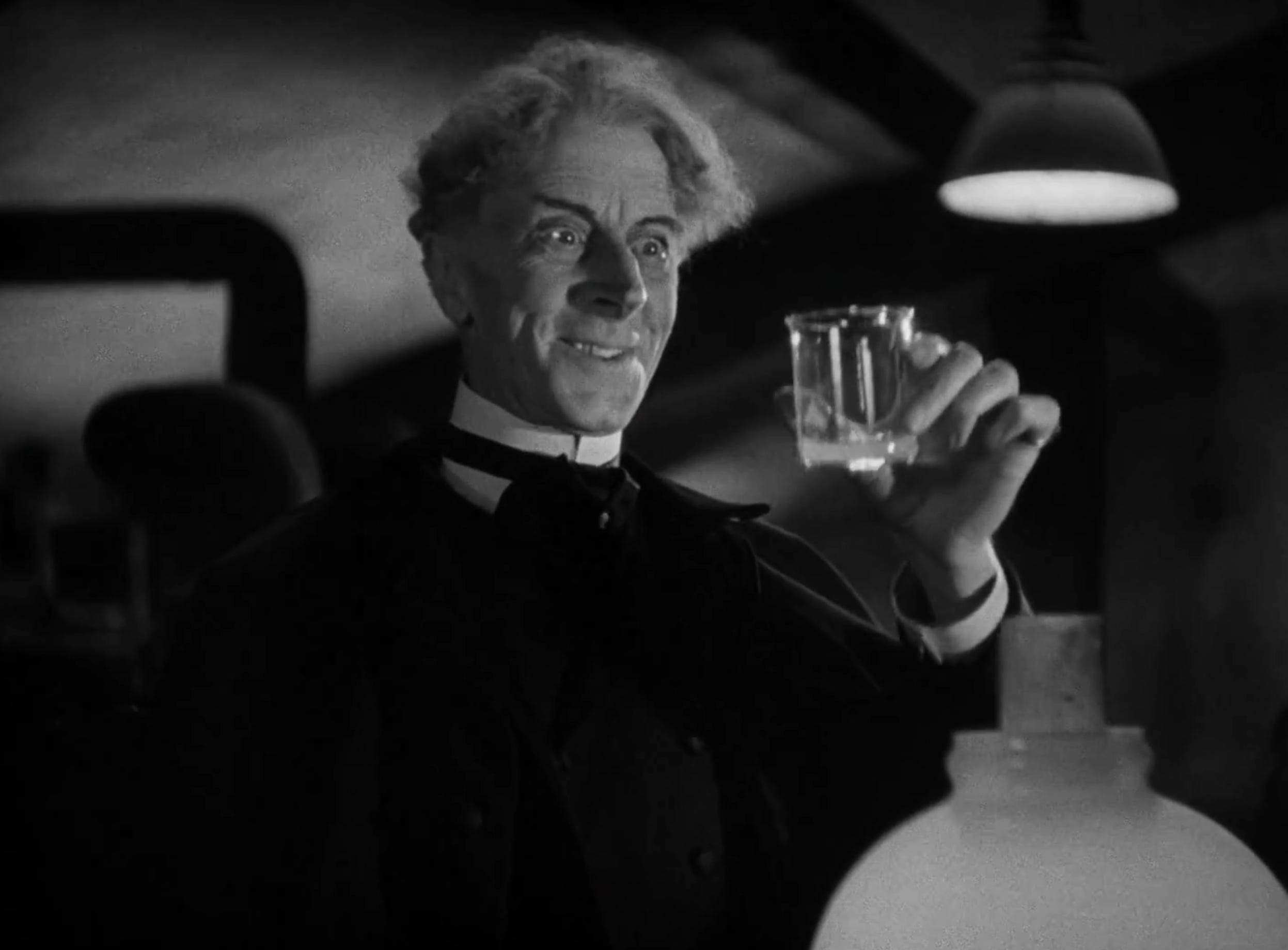
There is one particular scene in this picture that has withstood the test of time and spoken quite plainly to the reality of the genre. It’s the moment when Dr. Pretorius (Ernest Thesiger)—a character created solely for the film—offers a toast to Dr. Frankenstein (Colin Clive). As he does so, he toasts to a new age, a new age of “gods and monsters.”
If you’ve ever heard that term before, Bride of Frankenstein is where it originates. It’s a concept, a tagline, that suggests that mankind has the ability to create in a divine fashion, that we can strive beyond our limited human capabilities. It promotes the idea that we can harness divine power while committing unspeakable and chaotic marvels. It’s a goal that some strive toward, only to discover that when an imperfect human begin begins to play God, one cannot exist without the other.
For Pretorius, the work that Frankenstein started is not just a scientific or technical marvel. It’s a divine calling that he believes they must share. A calling to change the world by creating life apart from the Creator. This is, of course, the entire struggle of Shelley’s Frankenstein. In the novel, the titular doctor tempts fate by using his genius to create the Monster. Yet, upon its “birth,” he flees, disgusted and disturbed by his success.
When the murderous creature demands a mate, Frankenstein complies at first, but eventually destroys the unfinished creation, unwilling to make the same mistake twice. In Bride of Frankenstein, Pretorius uses the Monster to strong-arm Frankenstein into compliance, but even then, the Bride does not live long as the Monster itself recognizes that it does not belong in the land of the living.
For centuries we have long meditated on the idea of “playing God.” Film, television, and the literary arts are filled with these “deal with the Devil” bargains that come back to haunt us. Faust, Jurassic Park, Splice, The Strange Case of Dr. Jekyll and Mr. Hyde, The Prestige, The Lazarus Effect… But Frankenstein, a distinctly horror story, was one of the first in modern times to reinvent this wheel. It’s also, arguably, the most famous.
(It’s no wonder that Guillermo del Toro’s new Frankenstein film just finished up a limited theatrical release and is about to hit Netflix.)
What makes Frankenstein so compelling, and part of why we revisit it so often each October, is that it is a cautionary tale warning us of what might happen if we were to trust too deeply in our own human ingenuity and intelligence. It’s the idea that all progress, all advancement, must be good for the sake of itself. And yet, the novel (which was penned by Shelley when she was just over eighteen) suggests this is not the case. In it, we see that just because one can do something does not mean that one should. When one ignores the moral impulse to take a step back and relinquish that hunger for divine control, the results of said pursuit become clear.
When Frankenstein’s Monster turns out to be a vile abomination, the scientist regrets his greatest scientific breakthrough. He understands, too late, that man is given limits for a reason. That the powers of life itself are not ours to control. It’s because of his folly that the creature turns out so horrid. While man was created in the “imago Dei” (the image of God) from the very beginning in Genesis, Frankenstein’s genetic mutation is created in his own bent likeness.
But while Adam and Eve were first embraced by God in Eden, Frankenstein’s Monster is rejected by its maker. Frankenstein recognizes that he had scaled his own personal Tower of Babel, and judgment was soon to be upon him. The creature even compares his creation to that of Adam’s in the novel when he says…
Like Adam, I was apparently united by no link to any other being in existence; but his state was far different from mine in every other respect. He had come forth from the hands of God a perfect creature, happy and prosperous, guarded by the especial care of his Creator; he was allowed to converse with and acquire knowledge from beings of a superior nature, but I was wretched, helpless, and alone.
The horror in Frankenstein is not just the cold-blooded murder and revenge that the monster inflicts on his maker, nor is it the scientist that rejects his own creation. The true terror is of the depraved and diseased mind that made the beast to begin with.
What I appreciate about Pretorius’ on-screen toast to “gods and monsters” is the sheer honesty of it. The mad doctor believes with full sincerity that creating monsters is the pathway to creating gods. It’s the same story we read about in Genesis 6, when the fallen angels descend on mankind, reveling in their rejection of the Almighty by mating with women created in His image in order to produce their own twisted offspring: the Nephilim. It would take an act of God Himself for these creatures to be annihilated, and even after the Flood they continue to appear throughout the Old Testament story.1
But Frankenstein doesn’t see that tradition in his scientific efforts. He simply doesn’t care for it. Despite his creation’s various appeals to Milton’s Paradise Lost, Victor Frankenstein sees his vain efforts as “progress,” as modernity, as a post-Enlightenment breakthrough that could change the course of history.
It’s in pursuing a sort of man-made godhood that he becomes the very monster he fears.
If Frankenstein is largely about the folly of man’s attempts to play God, then Dracula is, at least in part, about the dangers of forsaking “primitive” religion for a sterile modernity that can do nothing in the face of true, pure evil.
When poor Lucy Westenra falls ill, modern medicine has no answers to help her. Nothing Dr. Seward does has any lasting effect because the ailment is not of a purely physical nature. As Dracula slowly turns Lucy to his cause, it’s only upon recognizing the deeper supernatural (and perhaps spiritual) truths of the situation—thanks to the efforts of Dr. Abraham Van Helsing, forever the traditionalist—that the vampiric Count is vanquished.
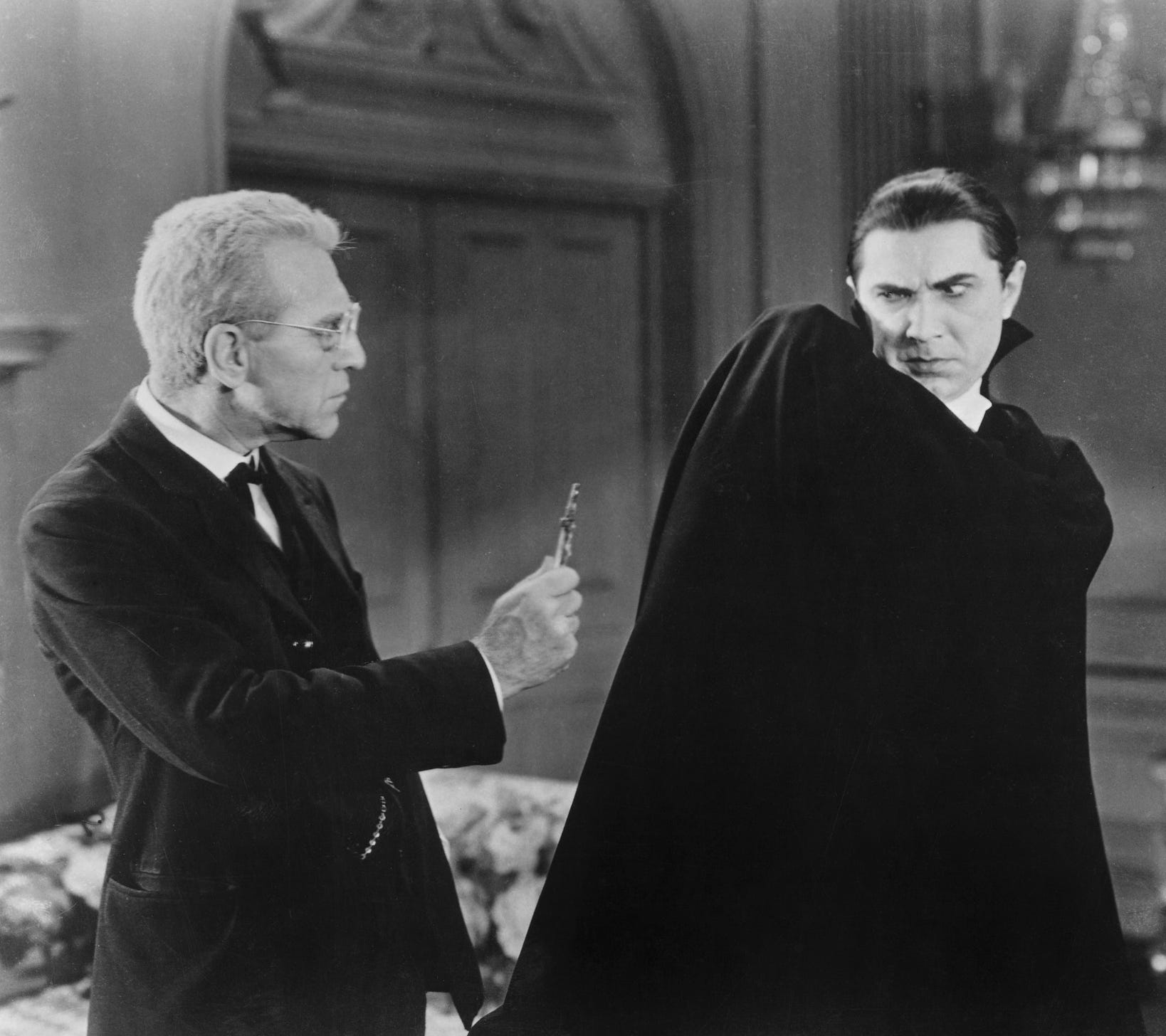
When Dracula begins, we see the villagers of Transylvania petition Jonathan Harker not to enter Castle Dracula. They know the evil there. But Jonathan is a good, modern Protestant. He believes in rational thinking and the scientific method. More than that, he sees the crucifix as nothing more than a superstition. Yet, it’s the traditional Christian symbol that ultimately saves his life. Without it, he would not have survived the seemingly impossible.
It’s here at the very beginning of his masterwork that Bram Stoker establishes the clear lines between good and evil. Lines that have existed since the dawn of time, lines that are often muddled in a modern, secular culture with a moral compass that points wherever the majority fall.
Stoker minces no words describing Dracula’s evil intentions and deeds, and he likewise makes no compromises with his merry band of vampire hunters, who are upright Christian men and women who utilize prayer, communion, and their God-given intellects to honor their Creator in the vanquishing of their dark foe. Although they use modern technology in their efforts, it’s the age-old notions of right and wrong, light and darkness, that help see them through to the end.
As Jacob Allee, the author of the Study the Great Books study guide for Dracula, said in his introduction to the tale:
Perhaps the greatest virtue of this story is the starkness of its portrayals. Good and evil are utterly clear and there is no gray. Dracula and his brides are utterly depraved in every way. The band who opposes them are self-sacrificing good people. The men in the story are masculine and the women are feminine. Dracula is a picture of broken and warped masculinity, what a man looks like when he has been utterly absorbed in vice and the brokenness of lust has consumed him.
As Allee later suggests, “What can overcome real evil but real good?”
There’s a tension in Dracula the novel that we often don’t see in most film adaptations. In the Hollywood versions of Stoker’s Gothic (even the one erroneously titled Bram Stoker’s Dracula), Dracula is often connected to Mina Harker through some sort of reincarnation, where she is directly related to his dearly departed wife from his previously human life. It makes one sympathetic towards Dracula, and often corrupts Mina far deeper than simple vampirism would allow.
I cannot stress clearly enough how much this addition misses the point.
In the novel, there is no love between Dracula and Mina, though there is a strong connection between them. Dracula is the total embodiment of pure evil. He is a domineering leech who seeks to feast on the lives of those around him solely for his own benefit and survival. After the vampire hunters kill the undead Lucy, the Count sets his sights on Mina.
But while Lucy succumbs to the allure of vampirism, Mina shows a strength of character and heart in resisting the pull of evil. Though Dracula fancies himself a god, Van Helsing and the others know him to be truly a monster. Even Mina recognizes this, though she cautions them to not simply war against the Count in hate, but to pity him.
I know that you must fight—that you must destroy even as you destroyed the false Lucy so that the true Lucy might live hereafter; but it is not a work of hate. That poor soul who has wrought all this misery is the saddest case of all. Just think what will be his joy when he, too, is destroyed in his worser part that his better part may have spiritual immortality. You must be pitiful to him, too, though it may not hold your hands from his destruction.
What is so remarkable about a tale like Dracula is that even in the face of the purest physical evil, a vampire who has killed her dearest friend, we see that Mina remembers that he too was once like her. She never once excuses his actions or dilutes his evil, but she sees the potential for evil within herself, the potential to become a monster. Hoping that her husband, Jonathan, would take pity on her if he had to kill her, she urges them not to fight Dracula with vengeance, but to do so out of compassion and love.
Hate is what fuels Dracula. His utter contempt for life itself has made him one of the undead, and through some obscene deal with the Devil, he has passed beyond the mortal coil—though he has not fully evaded it. He lives in an almost purgatory-like state between life and death, cursed to sleep with the dead and feed on the living. It’s quite a harrowing picture.
Because the vampire is so taken by darkness, he cannot be in the presence of the light. Yes, this manifests itself in the literal light of the sun, but also in the crucifix. This careful reminder that Christ defeated the works of the Devil2 is a terror he cannot overcome. It haunts him almost more fervently than he haunts his prey throughout, and it’s through sheer providence that he’s vanquished in the end.
Although we are never given specific answers as to how Count Dracula became a vampire, we can infer that, like Victor Frankenstein, he aimed to reach further than mankind was allowed. In seeking to become a god, he became a slave to his own murderous and lustful desires.
In the 2014 film Dracula Untold, the titular Count is connected directly to Vlad Țepeș, the Romanian hero who opposed the Ottoman Empire. Played here by Luke Evans, this interpretation shows Dracula temporarily becoming a vampire to save his family and his people. But the road to Hell is often soaked with the blood of those who chose evil for the sake of good. In the end, the newly minted vampire does not give up his bloodlust, instead choosing the life of a monster and forsaking his role as both father and king.
While this film may not be anywhere near Dracula’s true backstory, it’s an interesting take that echoes the choices made in Frankenstein. The horror genre has once again made it clear how easily one may slip into believing we deserve the power of God—and how disastrous are the results.
Dracula is a story that excels at using its hard line between light and darkness not as a crutch, but as a call to action. Although there are no vampires for us to quite literally behead or stake, there are enemies not of flesh and blood we ought to seek battle with.3 It’s only by holding fast to the teachings passed down from the last two-thousand years that we can be prepared for such warfare, and, just as Van Helsing and his merry band quickly learn, it’s only through prayer that we can receive the strength and wisdom to do so.

Today is Halloween. It’s also Reformation Day. Whichever you prefer to celebrate (or if you’re like me and appreciate both), I hope you find some time to kick back and revisit these tales of “gods” and monsters. I would submit to you that, if you do decide to give them another look, you may just find that they point more firmly to the ultimate Creator than you remembered.

Howdy, all! It’s been a hot minute. I apologize for the long delay, but there has been so much going on as of late that I’ve scarcely found time to sit down and relax let alone update this Substack. Nevertheless, I do have some exciting updates…
If you’ve been paying attention to this newsletter in the last two months, you’ve likely seen the interviews I’ve done with House of David director Jon Gunn and The Promised Land creator Mitch Hudson. If you haven’t done so yet, I implore you to check those out. In addition to the write up, you can always scroll all the way down and play the audio podcast version at your own convenience. There are more interviews in the works, so be sure to check back for that as well.
As far as my fiction work goes, I have some exciting news. For those who have come to love the gunslinging Weird Western hero Shane Cassidy as I have, more adventures are underway!
“Miracle at Bishop’s Bluff” was published in the Gunsmoke & Hexes: Tales of the Cursed Frontier anthology by Edge Weaver Books back in August, but that’s not all. As of today, October 31, 2025, the next Shane Cassidy adventure, “The Killer of Providence,” has been published in Silence and Starsong Magazine: Volume 2 Issue 2!
It’s such a thrill to publish with Silence & Starsong again. The team over there, especially editor Joseph Knowles, are great and I thoroughly enjoy working with them. That whole community is just such a blessing to be a part of. So far, they’re the first outlet to publish multiple Shane Cassidy installments, with “The Killer of Providence” technically being a prequel to “A Standoff at the Gates of Hell” (which appeared in Vol. 1 Issue 3 back in 2024).
(Even better, there’s another Shane Cassidy tale slated for a 2026 release. This isn’t with Silence & Starsong, however, so stay tuned for updates!)
Of course, if Westerns aren’t quite your thing (even supernatural-tinged Weird Westerns), don’t fret. If you’re like my good friend Harrison and are wondering if I’ll ever get back to The Bear-tooth Mountain Archive, you’re in luck. My plan in November is to dive back into finishing a story titled The Midnight of the Century, which takes place on New Year’s Eve, 1999, and follows two new characters who find themselves beneath the titular mountain.
It’s going to be great. I’m aiming for a December release for this one. Don’t worry, I’ll send an announcement out here when it drops on Kindle so that you don’t miss it.
TO READ: Revelation: Four Views - A Parallel Commentary, edited by Steve Gregg — Our pastor has been working through Revelation since March and we still have 10 or so chapters left. I started reading through this to better understand the historical, preterist, futurist, and spiritual views of the Apocalypse, and it’s been quite beneficial. Would highly recommend.
TO WATCH: Bride of Frankenstein — Could you tell that I love this movie? Halloween is the perfect time to jump into a monster flick. There’s no better place to start than Bride of Frankenstein. Well, maybe Lugosi’s Dracula, or possibly the first Frankenstein… But I like this film better, so give it a shot.
TO HEAR: Jesus and Johnny Cash — The girls have been asking their Mama to play them music in the mornings, with Johnny Cash being one of the most requested artists. Because my wife likes starting the day off slow, she prefers they listen to “Johnny Cash Jesus music,” which the Little Miss now requests more specifically. To that end, I made a playlist full of Cash’s hymns and spiritual tunes that the girls listen to pretty regularly. It’s a treat for us, so I hope it’ll be for you too. You can listen to the playlist on Spotify here.
Time and again the Nephilim’s heads would be crushed by the people of Israel, just as the Monster is continually beaten down over and again throughout Frankenstein. But unlike the creature, God doesn’t just spurn the real-life monsters of our day—He condemns them to chains in utter darkness. Where Frankenstein’s Monster outlives his maker, the fallen angels, giants, and wicked men who oppose the Lord simply don’t have a prayer against Him.
“Whoever makes a practice of sinning is of the devil, for the devil has been sinning from the beginning. The reason the Son of God appeared was to destroy the works of the devil.” - 1 John 3:8
“For we do not wrestle against flesh and blood, but against the rulers, against the authorities, against the cosmic powers over this present darkness, against the spiritual forces of evil in the heavenly places.” - Ephesians 6:12
Good one!
Love this!